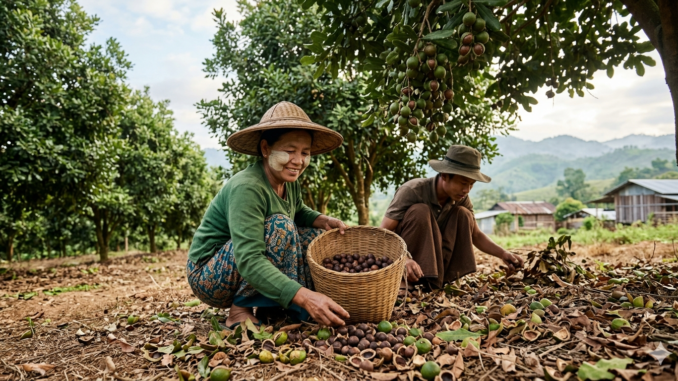
In Myanmar, macadamia nuts are unique in that they can yield two distinct harvest seasons per year due to the country’s tropical monsoon and subtropical highland climates. The primary cultivation hubs—predominantly located across Shan State (such as Ywangan and Nawnghkio townships), as well as parts of Kachin, Chin, and Mandalay—generally experience the following windows:
The Two Main Harvest Windows
- The Autumn Harvest (Primary Peak): This takes place around September to October/November. This follows the long accumulation of oil in the kernels over the summer months and aligns beautifully with the regional harvest cycles in neighboring southwestern China (such as Yunnan).
- The Spring Harvest (Secondary Peak): In specific microclimates and depending on the tree variety (particularly notable in parts of southern and south-western Shan State, such as Ywangan), a second, smaller harvest occurs in the Spring months, typically from March to April.
How Growers Identify Peak Ripeness
Because macadamia nuts on a single tree do not all mature at the same time, harvesting is an ongoing process rather than a single event. Farmers rely on a few specific indicators:
- Natural Drop: The most definitive sign of peak maturity is when the nuts naturally shed their outer husks slightly and drop to the ground. Shaking the trees is strongly discouraged as it dislodges unripe, low-oil-content nuts.
- The Husk Color Test: Inside the outer green fibrous husk, a perfectly ripe nut will show a rich chocolate-brown lining. If the inside of the husk is still white or sticky to the touch, it is underdeveloped.
- The Float Test: During initial processing, standard practice dictates checking the kernels in fresh water. High-quality, mature kernels have a high oil content and will float, whereas immature kernels sink.
Processing Timeline Note
Once gathered from the ground, the post-harvest clock ticks quickly. Best management practices in Myanmar dictate that the outer green husks must be removed within 24 hours of collection to prevent internal heating and mold. Following de-husking, the nuts undergo an extended drying process (often using hot-air ovens for commercial export) to reduce moisture content from roughly 30% down to 1.5% before they are sorted and cracked.